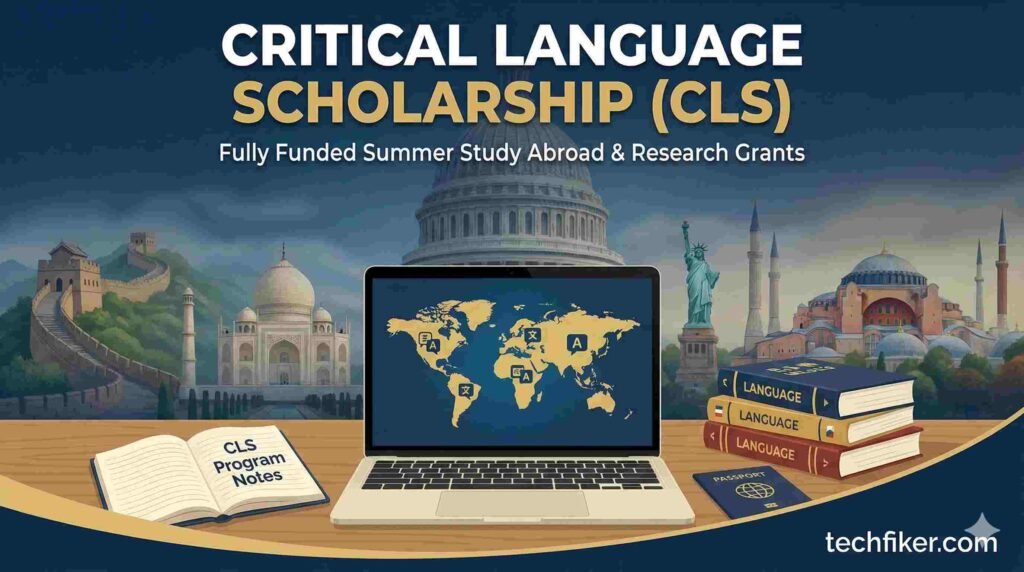
Are you a US student looking to travel the world for free while boosting your career in national security or international relations? The Critical Language Scholarship (CLS) Program is one of the most prestigious educational exchange programs sponsored by the US Department of State.
Designed to produce the next generation of global leaders, this fully funded opportunity allows American students to spend a summer overseas mastering foreign languages that are essential to America’s economic prosperity and security. If you aspire to be a Cultural Ambassador or secure federal government jobs, this program is your golden ticket. Unlike typical study abroad scholarships, the CLS program covers every single expense, meaning you won’t need to worry about student loans or tuition financing.
In this guide, we will break down the application process, eligibility criteria, and the massive career benefits—including Non-Competitive Eligibility (NCE) for US government employment.
What is the Critical Language Scholarship?
The Critical Language Scholarship (CLS) Program is an intensive overseas language and cultural immersion program for American students enrolled at U.S. colleges and universities. Students spend eight to ten weeks abroad studying one of over a dozen critical languages.
The program includes intensive language instruction and structured cultural enrichment experiences designed to promote rapid language gains. It plays a significant role in US foreign policy, as the government invests in students to become experts in regions vital to strategic interests. This makes Critical Language Scholarship (CLS) alumni highly sought after by recruiters for intelligence analysis, diplomacy, and international business.
Financial Benefits: What Does It Cover?
One of the main reasons this scholarship ranks as a top opportunity for US students is its comprehensive funding. You can put your student credit cards away because the US Department of State covers almost everything.
- Round-Trip Travel: Domestic and international airfare from your home city to the program site.
- Tuition & Fees: Full coverage of language instruction and cultural program costs.
- Room & Board: Housing (often with host families) and meals are provided.
- Living Stipend: A modest stipend to cover daily incidental expenses.
- Visa Fees: The program manages and pays for your entrance visa.
- Academic Credit: Undergraduate academic credit is issued through Bryn Mawr College.
Health and Insurance Coverage
While abroad, participants are covered by the Accident and Sickness Program for Exchanges (ASPE). This provides basic health benefits for emergencies. However, many cautious students also look into supplemental international student travel insurance to cover personal property or non-emergency care, ensuring they have comprehensive medical coverage while overseas.
List of CLS Languages
The scholarship is not for learning Spanish or French. It focuses on languages that are “critical” to the US.
- No Prior Experience Required: Azerbaijani, Hindi, Indonesian, Persian, Portuguese, Swahili, Turkish, Urdu.
- One Year Prior Study Required: Arabic, Chinese, Korean, Russian.
- Two Years Prior Study Required: Japanese.
Note: If you are looking for online language classes to meet these prerequisites, many universities offer summer institutes that qualify.
Eligibility Criteria: Who Can Apply?
The eligibility rules are strict but simple. To apply for these research grants and study awards, you must meet the following at the time of application:
- Citizenship: You must be a U.S. Citizen. (Permanent residents are not eligible).
- Enrollment: You must be enrolled in an accredited U.S. degree-granting program (undergraduate or graduate) at the time of application.
- Age: You must be at least 18 years old.
- Health: You must be physically and mentally able to participate in an intensive program.
Career Benefits: The “Golden Ticket” for Federal Jobs
Beyond the free travel, the biggest asset of Critical Language Scholarship is the Non-Competitive Eligibility (NCE) status.
Upon successfully completing the program, alumni receive NCE for US Government jobs. This allows federal agencies (like the State Department, USAID, or DoD) to hire you outside the formal competitive job announcement process. It significantly fast-tracks your path to becoming a Foreign Service Officer or civil servant.
How to Prepare for CLS 2026: A Strategic Roadmap
Since the application window is short (September to November), successful candidates often start preparing months in advance. If you are a student reading this in January or February, you have a huge advantage. Here is how to use your time wisely to build a winning profile.
Phase 1: Research & Strategy (January – May)
- Select Your Language Wisely: Don’t just pick a language because it sounds cool. Choose one that aligns with your career goals and national security interests. Ask yourself: How will learning Urdu or Russian help me get a job in the federal government or international business?
- Check Prerequisites: If you are targeting a language like Arabic, Chinese, or Russian, ensure you are enrolled in the necessary university courses now to meet the “one year of prior study” requirement by the time you apply.
- Boost Your GPA: While CLS is holistic, a strong academic record helps. Consider hiring a tutor if you are struggling in core classes.
Phase 2: Build Your “Soft Skills” (June – August)
- Demonstrate Cultural Adaptability: The selection committee looks for resilience. Get involved in campus organizations, volunteer with immigrant communities, or engage in cross-cultural exchanges. This gives you great material for your “Resilience” and “Adaptability” essays.
- Connect with Professors: You will need a strong recommendation letter. Start attending office hours now. Professors write better letters for students they actually know.
- Start Learning Basics: Even for languages with no prerequisites (like Swahili or Indonesian), showing you have started self-study using language learning apps or online courses demonstrates initiative.
Phase 3: The Writing Process (September – October)
- Draft Early: The essays are short (usually 200-300 words), which makes them harder to write. You need to be concise.
- Focus on the “Why”: Your Statement of Purpose shouldn’t just be “I love languages.” It must be: “I need this language to solve [Specific Problem] in my future career as a [Job Title].”
- Get Feedback: Visit your university’s writing center or ask a mentor to review your drafts
Required Documents & Application Process
The application is entirely online. Since this is a merit-based competition, your essays matter more than your GPA.
- Unofficial Transcripts: Upload current transcripts from your US university.
- Letter of Recommendation: One robust letter from a professor or professional supervisor.
- Short Essay Questions: You will write four essays on:
- Resilience: How you handle stress and new environments.
- Cultural Adaptability: Your ability to respect and integrate into other cultures.
- Statement of Purpose: How this language fits your academic and professional future.
- Citizen Diplomacy: How you will represent the USA abroad.
Tip: When writing your essays, use keywords related to “mutual understanding,” “future career goals,” and “national service.”
Step-by-Step Application Timeline
- September/October: Application opens online.
- Mid-November: Application Deadline (Strict cutoff).
- January: First round of reviews (Seminfinalists notified).
- March: Finalists notified.
- June – August: Program takes place abroad.
Frequently Asked Questions (FAQs)
Q: Can I apply if I have zero knowledge of the language?
Yes! For languages like Hindi, Urdu, Swahili, and Turkish, no prior study is required. This is a perfect way to start a new language learning journey.
Q: Does Critical Language Scholarship affect my financial aid or student loans?
Generally, no. Since it is a summer program, it usually doesn’t interfere with regular semester aid. However, you should check with your university’s financial aid office to see if you can defer student loan payments while you are away.
Q: Can I bring my family?
No. This is an immersive cohort program. Dependents are not supported. If you have family obligations, you might need to explore other family-friendly research grants.
Summary of CLS Program
| Feature | Details |
| Scholarship Name | Critical Language Scholarship (CLS) |
| Sponsor | U.S. Department of State |
| Coverage | Fully Funded (Flight, Tuition, Stipend, Visa) |
| Key Benefit | Non-Competitive Eligibility (NCE) for Federal Jobs |
| Duration | 8 to 10 Weeks (Summer) |
| Eligible Citizens | U.S. Citizens Only |
| Revenue Keyword Focus | Student Travel Insurance, Federal Jobs, Language Training |
This program is more than a summer trip; it is a career-defining experience. If you are ready to serve as a Cultural Ambassador and gain skills that make you indispensable to the global workforce, start your application this fall.
Official Website:
Looking for More Scholarships?